Ben Ezra Synagogue in Coptic Cairo

Ben Ezra Synagogue in Coptic Cairo is one of Egypt’s most important and famous synagogues. It is considered the oldest synagogue in Egypt. It dates back to the 9th century AD.

This synagogue had an old copy of the Old Testament, and it is believed that it was written by the prophet Ezra or Al-Azir, so it is called the Ben Ezra Synagogue.

The history of this Synagogue: Originally, this building was a Christian church called El-Shamieen Church. But in 882, it was being sold to a group of Jews led by the Jewish religious scholar and philosopher Abraham Ben Ezra for 20,000 dinars.

It is built in the shape of a basilica style. It includes two floors. The first floor is dedicated to men and contains the bimah, while the second is dedicated to women.

It is decorated in Arabesque style and inlaid with mother of pearl, displaying a merge of artistic traditions.

Stories about this synagogue: It is said that this place of this Synagogue was where the box of Baby Moses was found.

Museum of Islamic Art (MIA)

The Museum of Islamic Art of MIA is the largest Islamic Art Museum in the world, as it houses close to a hundred thousand antique Islamic artifacts of various types collected from India, Iran, all the way to the Arabian Peninsula, the Levant, Egypt, North Africa, and Andalusia.

This collection is characterized by its breadth of coverage of all the branches of Islamic art throughout the ages (from the beginning of the Islamic era up to the period of the family of Mohamed Ali), which makes it a beacon of Islamic Art and Civilization for all times.  These collections vary between rare woodwork, plaster artifacts, metal, ceramic, glass, crystal, and textile objects. The museum displays these collections in 25 Halls. Some halls are a chronology, while some are thematic.

The history of MIA Originally, the museum did not be existing in this place. In 1881, Julius Franz suggested allocating a part in Al-Hakim Mosque to be a museum for displaying 111 objects of Islamic Art, and it was called the Arab Museum. These collections kept increasing, resulting in the construction of the current building in 1903 by Khedive Abbas Helmy II, in Bab al-Khalq in the heart of Historic Cairo.

Cairo Tower on Gezira Island

Cairo Tower lies on Gezira Island in the River Nile. It is considered one of the most famous modern monuments in Cairo, Egypt.

It was founded in 1961 during the Gamal Abdel Nasser period and was designed by the Egyptian architect Naoum Shebib. This design is inspired by the lotus plant, one of the most important plants in ancient Egyptian civilization. Its tall is 187 M, which makes it considered the tallest building in Egypt.

Let take a tour inside the tower The tower consists of 16 floors. Take the elevator to reach the last floor at 45 seconds. It is advised to go up to the tower, where you will find a circular observation deck and a revolving restaurant allowing you to see the attractions of Cairo, the city of the thousand minarets, and enjoy taking photos during fabulous sunset.

Cairo Tower Today The Ministry of Tourism and Antiquities and the Egyptian government launched the initiative to illuminate the Egyptian sightseeing as the great pyramid of Cheops in Giza plateau and Cairo Tower to send a message for the whole world. This message contains (Stay Home – Stay Save). This message aims to urge people to stay at their homes to reduce the spread of Coronavirus COVID-19 and protect themselves from it.

El Moez Street in Old Cairo

El Moez Street or El Moez li-Din Allah al-Fatimi Street is one of the oldest streets in Cairo city. It was founded within the construction of Cairo city during the Fatimid period under the caliph Al-Mu’izz li-Din Allah.

El Moez St. runs from the north, where the gate of Bab al-Futuh to the south, where the gate of Bab Zuweila. Both entrances were established by the vizier Badr al-Jamali in the 11th century when he rebuilt some buildings in Cairo city, including its walls. Its length is approx. one kilometer long, which makes it considered one of the longest streets in the walled city.

The vital role of this street made people were building in it souqs as Khan El khalili Bazaar, religious buildings as Al-Hakim Mosque, and charitable buildings as Madrasa of Barquq. These buildings date back to different Islamic periods such as the Abbasid, Fatimid, Mamluk, and Ottoman periods.

  • Madrasa of Barquq: This complex contains a mosque, a mausoleum, and a school. This school or madrasa (in the Arabic language) was for teaching the four Islamic schools.
  • Al-Hakim Mosque:It lies beside the gate of Bab al-Futuh in the north of Cairo city. This mosque originally built by Al-Aziz, the father of Al-Hakim, but Al-Hakim completed it, so the mosque is called Al-Hakim Mosque.

Sabil of Sulayman Agha al-Silahdar: This sabil is a good example for displaying how people used to drink in old times while walking around the street.

Khan El khalili Bazaar in Islamic Cairo

Khan El khalili Bazaar is the most famous souq, It was built in the Mamluk period as a center of trade.

Also, it includes workshops for the Egyptian artisans, who create and produce traditional crafts and souvenirs.

Let’s know about the history of this bazaar When the Fatimids founded Cairo city, they divided it into two sections. The first one contained the eastern royal palace, while the second houses the western royal palace. Today, the location of Khan El-Khalili Bazaar is the southern end of the eastern Fatimid Palace.

Dajaharks Al-Khalili founded this bazaar in the 14th century, so it is called El khalili Bazaar.

The design of the bazaar was multi-storied structures. The bazaar centered around an inner peristyle courtyard, where traders could store their merchandise, while the upper levels were used for housing.

The bazaar contains several coffeehouses, shops, and restaurants. The most famous traditional Arabic coffee there is El Fishawi. In this coffee, the Egyptian author Naguib Mahfouz spent a lot of time.

Salah El-Din Citadel in Islamic Cairo

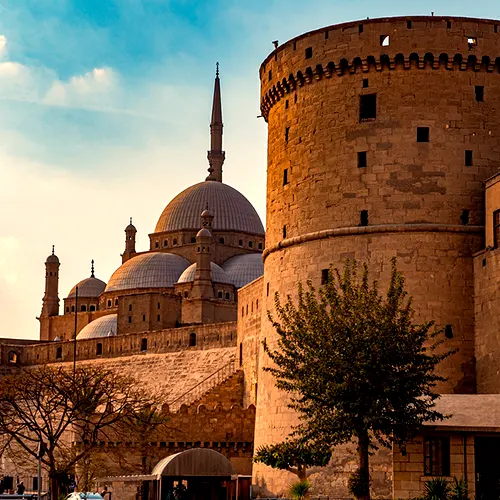
Salah El-Din Citadel or Cairo Citadel is built by Salah El-Din Al-Ayoubi, the founder of the Ayyubid Dynasty in 1176 to be a fortress and seat of rule for nearly 700 years. It stopped being the seat of the rule when Khedive Ismail transferred it to Abdeen Palace in 1874.

Salah El-Din Al-Ayoubi decided to construct this citadel on Mokattam hills for use this strategic position allowing him to expose the whole city and made it difficult to attack. In 1976, UNESCO considered it one of the heritage sites in Islamic Cairo.

This citadel houses several museums as the National Military Museum and the Police Museum and mosques as Sultan Al-Nasir Muhammad Mosque, Mosque of Suleiman Pasha El Khadim, and Muhammad Ali Mosque.

Al-Nasir Muhammad Mosque It was built in the Mamluk period in 1318. It distinguishes with its green Dom.

Muhammad Ali Mosque Muhammad Ali Pasha began its construction in 1830, but it was completed in 1857 by Said Pasha, son of Muhammad Ali Pasha. Muhammad Ali Pasha willed to be buried in this mosque so you can see his cemetery inside the mosque.

Muhammad Ali Mosque is also known as the Alabaster Mosque due to its walls are coated with alabaster. It was established in Turkish, as the mosque is divided into two parts. The first part is the courtyard, while the second is the house of prayer. Also, it distinguishes with its domes and minarets taking the pencil shape. Some opinions believe that this mosque is similar to the blue mosque belonging to Sultan Ahmed in Turkey.

The Egyptian Museum in Tahrir Square

This museum is the most famous landmark in Egypt, holding great and unique ancient Egyptian collections.

Let’s go back a little bit before building the Egyptian Museum Due to the discoveries of Napoleon Bonaparte’s expedition, Egypt built the Cairo Museum to conserve the objects. This museum was an initial house at Ezbakiyya. Unfortunately, in 1855, Abbas Pasha gave the museum contents to the Duke of Austria and ordered the closing of the Cairo Museum in Ezbakiyya.

In 1858, Auguste Mariette proposed to establish a new museum in Boulaq to house the ancient Egyptian monuments. But misfortune for the second time, this museum was washed away by the annual flooding of the Nile River.

In 1881, Maspero reopened the Boulaq Museum and became its director.  In 1891, the contents of the Boulaq Museum were transferred to the palace of Khedive Ismail.

On November 15, 1902, the current museum in Tahrir Square is opened by Khedive Abbas Helmy II result of Maspero’s suggestion to exhibit the contents which were in the palace of Khedive Ismail.

Let’s go on a tour in the Egyptian Museum The design of Museum building was selected in an international competition launched in 1895. The uniqueness in this design is that it is mixing between ancient Egyptian and Greco-Roman styles.

The museum houses approx. unparalleled 160,000 objects dating from the prehistoric period to the Greco-Roman period displayed on two floors in 107 halls.

These unique collections are such as the statuette of King Cheops, Narmer Palette, Thuya and Yuya treasures, jewelry of Tanis, etc.

Gayer Anderson Museum or Bayt Al-Kritliyya

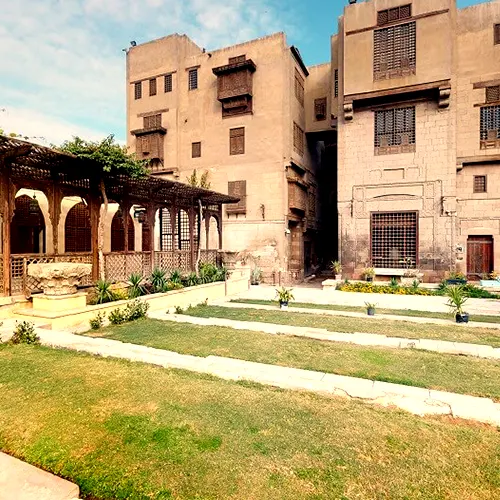
Gayer Anderson Museum, or Bayt Al-Kritliyya, is one of the most perfect examples of Islamic domestic architecture in Islamic Cairo; It is located beside Ibn Tulun Mosque. This museum consists of two houses.

The first house is on the east. It was founded by Hajj Mohammad Al-Gazzar in 1632. Later, this house was bought by a lady from Crete Island, so it is called Bayt Al-Kritliyya or Al-Kritliyya House.

The second one is on the west. It was built in 1540. It was called the house of Amna bint Salim. Later, these two houses were connected by a bridge.

But who is Gayer Anderson    Robert Gayer Anderson was a doctor in the British army. He decided to stay in Egypt and bought this house in 1935. After Robert Gayer Anderson’s death, this house is changed to be a museum displaying Gayer Anderson’s collections like oil paintings and ancient Egyptian collections.

Let’s take a tour in the rooms of this house 1 – The Sabil Room or the public drinking fountain. Now, this room displays collections exhibiting the legends of the house.

2 – Then, after ascending a few steps on the west side of the house, you with find the loggia. Enjoy its view and taking amazing photos.

3 – Then, the reception hall, distinguishing with its Islamic decorations.

4 – The picture gallery. In this room, you will find the oil paintings and drawings collected by Gayer Anderson.

5 – Then move to the museum room to see the ancient Egyptian collections of Gayer Anderson.

6 – You will ascend to the roof terrace to be amazed by this view overlooking Ibn Tulun Mosque.

7 – At the end of your tour, you will find a room displaying Gayer Anderson’s medical tools because he was an obstetrician and gynecologist.

The Egyptian Royal Mummies Parade

On April 3rd, Pharaohs will be in a New Museum. Egypt waits for a great historical event (Royal Mummies Parade). The Ministry of Tourism and Antiquities is preparing to transfer the royal mummies from the Egyptian Museum in Tahrir Square to a new home, to the National Museum of Egyptian Civilization (NMEC).

For getting ready for the Royal Mummies Parade, the Egyptian government and the Ministry of Tourism and Antiquities develop and decorate Tahrir Square by adding an ancient Egyptian obelisk and four ram-headed sphinxes.

Twenty-Two Pharaonic mummies of Kings and queens will be moved in a royal procession using vintage cars, horses, chariots, and musical shows. This parade will start from Tahrir Square, passing beside the Nile corniche, and reach its final destination in the National Museum of Egyptian Civilization in Fustat.

These Twenty-Two Pharaonic mummies of Kings and queens are eighteen mummies for kings and four mummies for queens. Those kings and queens are Seqnen Ra, Thutmose I, Thutmose II, Hatshepsut, Thutmose III, Thutmose IV, Amenhotep I, Amenhotep II, Amenhotep III, Seti I, Ramses II, Seti II, Ramses III, Ramses IV, Ramses V, Ramses VI, Ramses IX, Ahmose Nefertari, Merit Amon, Siptah, Merenptah, and Queen Tiye.

  • The first cache was found south of Dier El-Bahri Luxor in 1881 in tomb 320. In 1871 a member of the Abdul Rassul family found a corridor. He entered it to find a treasure of gold and coffins. The family kept their discovery secret, but the discoverer of the tomb asked for more money; this started a fight, and the entire story came out what led to that the Egyptian government began to move all forty royal and non-royal mummies to Cairo in 1881 and entered the Egyptian Museum.
  • The second cache was found by Victor Loret in 1898 behind a decorated wall in the Amenhotep II tomb.  The number of royal mummies is 9 mummies.
  • The third cache was found in Deir El-Bahri, also by the Abdul Rassul family near the tomb of Queen Neferu.  This cache had mummies that were dated to the 21st Dynasty and belonged to the priests of Amon.

These mummies, coffins, and sarcophagus were moved to the Egyptian Museum in 1892, and their number was one hundred and fifty-three coffins.

Abusir Necropolis – Historical Site

Abusir Necropolis is considered an essential part of the Memphis Necropolis, where the ancient Egyptian kings of the fifth dynasty built their pyramids.

Abusir Necropolis houses fourteen pyramids, but the most famous pyramids there are the pyramids of king Neferirkare, Niuserre, and Sahure, dating back to the fifth dynasty.  Additionally, the temple of the sun distinguishing the fifth dynasty and tombs are belonging to members of the royal family as the mastaba of Prince Nakhtkare.

  • The third dynasty: the tomb of Ity and the tomb of Hetepi.
  • The fourth dynasty: the tomb of Kaaper, architect, and priest.
  • The fifth dynasty: the tomb of Rahotep, the tomb of Fetekti, and the mastaba of Ptahshepses.
  • The sixth dynasty: the tomb of Qar and his sons.

What do you think Abusir means? The name of Abusir is derived from the ancient Egyptian word (Pw-Wsjr), meaning the House or Temple of the god Osiris.