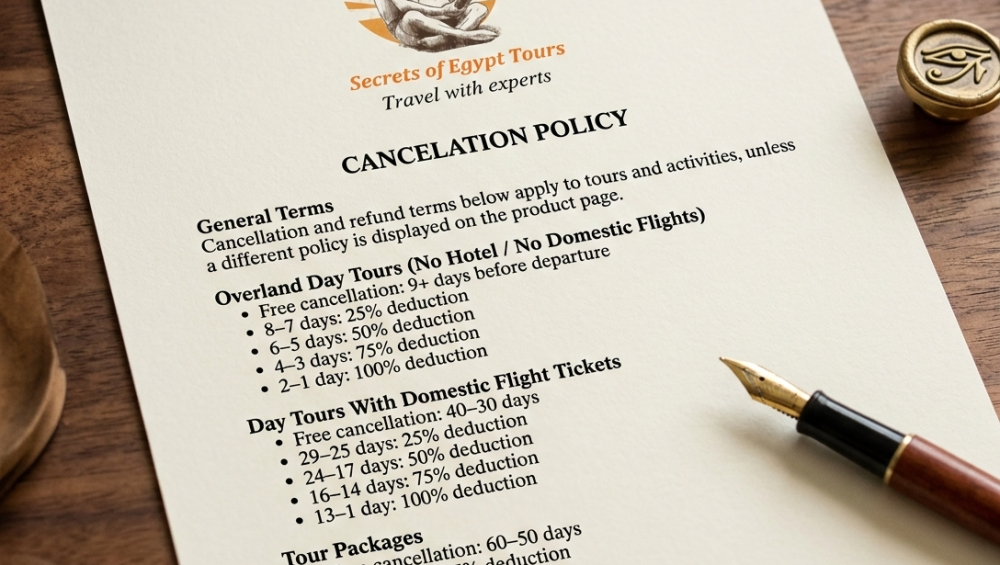
Cancellation Policy of Secrets of Egypt Tours

Overland Day Tours (No Hotel / No Domestic Flights)

Free cancellation: 9+ days before departure

8–7 days: 25% deduction

6–5 days: 50% deduction

4–3 days: 75% deduction

2–1 day: 100% deduction

Day Tours With Domestic Flight Tickets

Free cancellation: 40–30 days

29–25 days: 25% deduction

24–17 days: 50% deduction

16–14 days: 75% deduction

13–1 day: 100% deduction

TOUR PACKAGES

Free cancellation: 60–50 days

49–35 days: 25% deduction

34–30 days: 50% deduction

29–20 days: 75% deduction

19–1 day: 100% deduction

Special Permits Tours

100% deduction (Non-Refundable).

POSTPONDING YOUR TOUR

If you need to change your tour date, please contact us and we will do our best to help. Once a new date is confirmed by mutual agreement, the booking may become non-refundable if you later choose to cancel (depending on supplier policies and the new agreement).

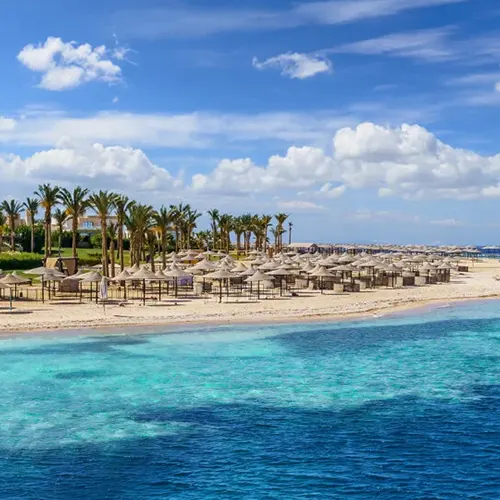
Tourism in Marsa Alam – the Red Sea

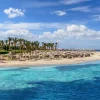
Marsa Alam is a port and resort located on the Red Sea in the eastern desert, 280 kilometers south of Hurghada. After the opening of the Marsa Alam International Airport in 2001, Marsa Alam becomes an important destination for tourism from different European trips, especially from Italy.

The history of Marsa AlamIn ancient times, Marsa Alam was famous for its mountains used in mining and digging for gold and emeralds, as an ancient town dating back to the ancient Egyptian civilization is discovered in Marsa Alam by the supreme council of antiquates.
Marsa Alam is divided into two villages. The first is Bernice that is a small city located north of Al Quseir. This village is famous for therapeutic tourism. The second village is Abu El Hassan Al Shazly village, housing a famous Islamic center.

    Activates in Marsa Alam
  • Enjoying diving, snorkeling, and submarine trips in the Red Sea and seeing coral reefs and the wide range of underwater wildlife such as dugongs and dolphins. The levels of diving vary to be accessible for less experienced divers and experienced drivers.
  • Marsa Alam includes several marinas offering the best service as Spas for relaxation and entertainment.
  • Marsa Alam is famous for kite surfing and windsurfers.
  • In Marsa Alam, you will be able to enjoy doing safaris in the desert and wilderness exploration.
  • Marsa Alam houses many National Parks such as Gebel Elba, Hamata Island, and Wadi al Gimal, where a variety of birds and desert animals.
  • Also, Marsa Alam is considered a therapeutic tourism destination.
  • In addition, it has great economic importance as it contains many golds, emeralds, and marble mines.>

Several tourism projects are planned for the near future in Marsa Alam to become rival the popularity of the other Egyptian resorts such as Hurghada and Sharm El-Sheikh.

Bahariya Oasis – The Western Desert

Bahariya Oasis is one of the most fabulous Egyptian oases in the western desert, as Egypt contains six oases El Fayoum Oasis, Farafra Oasis, Farafra Oasis, Kharga Oasis, Dakhla Oasis, and Siwa Oasis. It is affiliated with Giza Governorate.

The history of Bahariya Oasis Like other Egyptian oases, Bahariya Oasis was an important stop point on the trading route between the Western Desert and the Nile Valley.

Bahariya Oasis are two Arabic words meaning the northern oasis in English. This oasis played an important role during the ancient Egyptian civilization as it was known with two names (Djesdjes) and (wḥꜣt mḥtt).

Its importance increased during the Greco-Roman period as it was used as a trading route and began producing a lot of goods such as cereals, dates, olive oils, and wine.

The main economic sectors of this society are iron ore mining, tourism, and agriculture as they are growing guavas, mangos, dates, and olives.

The attractions in Bahariya Oasis Bahariya Oasis is surrounded by mountains and has numerous springs. It is considered as the start point for many safari trips into the western desert as it is the closest oasis to Cairo, as well provides immediate access to the White Desert, Black Desert, and the Crystal Mountain.

  • El Bawiti is the largest and the administrative center in Bahariya.
  • El Hayz: In El Hayz, the golden mummies have been discovered. It is a necropolis housing nearly 10,000 mummies dating back to the Greco-Roman period.
  • Bir Al-Ghaba: it is a hot spring worth visiting in this oasis.
  • Bawiti Museum: it is an Ethnographic museum displaying the customs and traditions community of Bahariya Oasis. It was built by Mohamed Eid, one of the oasis’s local artists.
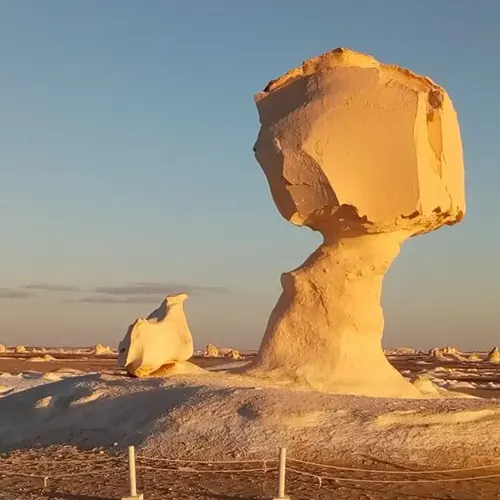
  • The White Desert is divided into two deserts: the old white desert, where the Mushrooms and tents area, and the new white desert with its limestone formations. In ancient times, this desert was covered with the sea leading to its rocks contain some seashells. It is located on the road between Bahariya and Farafra.
The White Desert
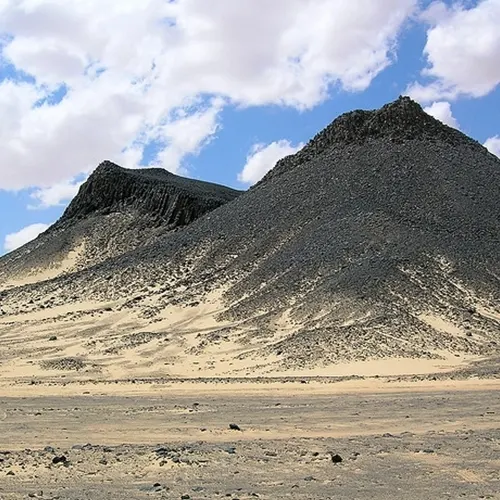
  • The Black Desert contains mountains formed from black stones and rocks created due to volcanoes.

The Black Desert

Farafra Oasis – The Western Desert

Farafra Oasis is one of the most fabulous Egyptian oases in the western desert, as Egypt contains six oases El Fayoum Oasis, Bahariya Oasis, Farafra Oasis, Kharga Oasis, Dakhla Oasis, and Siwa Oasis.

Farafra is located on the southern road between Cairo and Bahariya. Farafra Oasis is affiliated to the Al-Wadi Al-Gadid governorate in Southern Egypt, the largest governorate in Egypt in terms of space.

The history of Farafra Oasis As other Egyptian oases, Farafra Oasis was an important stop point on the trading route between the Western Desert and the Nile Valley.

Farafra Oasis had a great position during the ancient Egyptian civilization, especially during the reign of the 10th dynasty, as it was named (Ana Akhet), meaning the land of the cow referring to the goddess Hathour.

During the Roman period, Farafra and other oases were famous for growing grains.

During the Coptic period, the Egyptian Copts escaped to Farafra and other oases due to Roman persecution.

This oasis is considered partly isolated what explains why its community still committing to its old traditions and customs. It is famous for growing dates, olives, and apricots.

The attractions in Farafra OasisFarafra is the start point for tours desert safari in the western desert to visit the white desert, the black desert, and the Crystal Mountains.

  • The Qaser Al Farafra or the Farafra Palace is a roman monument.
  • Qaser Abu Monqar is a roman attraction.
  • Farafra Oasis houses other roman attractions as some rock-cut tombs and ruins of a Roman Temple.
  • The White Desert is divided into two deserts: the old white desert, where the Mushrooms and tents area, and the new white desert with its limestone formations. In ancient times, this desert was covered with the sea leading to its rocks contain some seashells. It is located on the road between Bahariya and Farafra.
The White Desert
  • The Black Desert contains mountains formed from black stones and rocks created due to volcanoes.
The Black Desert
  • Badr’s Museum: it is a mud-brick house owned by Badr Abdel Moghny, who is a local artist. It displays the customs and traditions of the Farafra community.
Badr’s Museum
  • Farafra distinguishes with its geographical location and geological formation, so it contains natural water wells using in therapeutic tourism as it has sulfurous wells for treating some respiratory diseases.