Is it safe to visit Egypt in 2021?

Many people dream of visiting Egypt, as it is the cradle of civilization and comes at the top in containing wonders for ancient history. But due to the current issues in the whole world (COVID-19), they always ask that (Is it safe to visit Egypt in 2021?).

If you are asking (Is it safe to visit Egypt?) due to the current COVID-19 situation, we will answer you? Egypt, like the rest of the countries around the world, had a hard time as tourism took a nosedive. But now, things are looking up due to adherence to safety and security precautions in several sectors of the country.

Additionally, World Health Organization (WHO) praises procedures taking by Egypt for reducing the outbreak of coronavirus.  WHO published that Egypt is one of the least countries with cases infected with coronavirus until now.

So do not be hesitant to travel to Egypt right now. We will tell why you should get this chance.

  • If you visited Egypt before, of course, you found some attractions are stack with tourists. But now, you will be more enjoying these places as they will not be over-packed with tourists.
  • Travel agencies are desperate for you, making the prices incredibly cheap.
  • The security is at an all-time high as it pledges to implement precautionary measures and discourage any attacks.

Egypt is perfectly safe for visiting, but taking a bit of precaution is never wrong. You have to stick to the rules, do not look for trouble, respect the culture, stay aware of your surroundings, and keep an eye on your belongings to have an enjoyable visit.

  • Make sure that the travel company planning your itinerary in Egypt is reputable and will offer you all amenities and safety.
  • Keep a copy of your identification.
  • Get a SIM card.
  • Stay away from any crowds in general.
  • Stay out of the sun, use your sunscreen, and Keep a water bottle on you.

The Reviving of the Grand Avenue of Sphinxes

As Egypt grabbed the attention of the whole world to Cairo during the royal Mummies parade when they were transferred from the Egyptian Museum in Tahrir Square to their final destination to the National Museum of Egyptian Civilization. Egypt will grab the attention of the whole world again, but this time will be in Luxor, especially in the east bank of Luxor city. Luxor city is preparing for a celebration for reviving of the grand avenue of sphinxes at the end of June after its development and restoration.

The correct name of this road is the road of the great parades or the road of the religious celebrations and parades.

The history of the grand avenue of sphinxes The excavations in this avenue started on the 18th of March 1949 by the archaeologist Zakaria Ghoneim. The work continued till it stopped in 2011 due to the revolution of the 25th of January 2011, and it has been resumed again in 2017.

We knew about this avenue from a depiction in the red chamber of Queen Hatshepsut at Karnak Complex, as Hatshepsut said that she constructed a road for her father the god Amun-Ra to pass through it during his feasts as Opet feast from Luxor Temple to Karnak Complex, vice versa.

Also, she mentioned that she decorated this road with statues and 6 chambers for a break to the Holy boats of the triad of Thebes (Amun, Mut, and Khonsu).

Throughout ancient Egyptian history, several kings added statues to this road either headed with human head or ram head. It is thought that the construction of the avenue started during the New Kingdom and was completed in the 30th Dynasty during the rule of King Nectanebo I.

This avenue is divided into two parts. The first part is in front of Luxor Temple containing sphinxes statues with a human head and lion body, while the second part is in front of Karnak Complex headed with rams. All these statues were made from one block of sandstone.

This avenue connects Karnak Complex with Luxor Temple, passing by the domain of Mut. The statues are about 1200 statues on both sides. They look like that they guard those who using this avenue between the two temples.

The celebration of reviving of the avenue of sphinxes The avenue of sphinxes is an archaeological site belonging to Thebes as World Heritage Site and considered as one of the most important attractions in the east bank of Luxor city.

The reviving of this avenue will turn the east bank of Luxor into an open-air museum, as the tourist will be able to visit Luxor Temple from Karnak Complex via walking through the avenue of sphinxes, which makes this site considered the world’s largest ancient site.

In this event, the grand avenue of sphinxes will be completely opened. It is about 2,700 meters long and about 7 meters wide, with 1200 statue on both sides.

How can you visit the avenue of sphinxes? You will be able to visit it from Karnak Complex, or Luxor Temple, or through three side entrances. On the side of the avenue, there is a museum that will be existed to display the collection discovered during the excavations in the avenue of sphinxes. Additionally, you will see some wine presses, baths, and Nilometer.

The avenue of sphinxes will be lighted at night for visiting for more enjoyment with the ancient Egyptian magic.

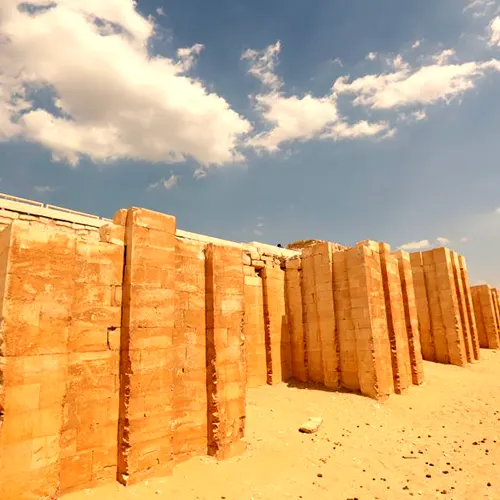
The Southern Tomb of Zoser in Saqqara

The Southern Tomb Location and dimensionsIn the southern end of the Great Court is a long building with a low, vaulted roof known as the South Tomb. The elements of the substructure are very similar to those of the pyramid (although on a reduced scale) but differ somewhat in their arrangement. The burial chamber was at the bottom of a vertical shaft, 7 x 7 metres and 28 metres deep—the same dimensions as the one under the pyramid and on more or less the same North-South axis. It was made out of the same pink granite and there is even evidence for an earlier limestone version with stars carved into the ceiling. The interior of the tomb was far less disturbed by robbers than the Step Pyramid and the ‘manoeuvre chamber’ has survived reasonably intact. Even the beam used to lower the granite plug was still in place. The walls were of limestone and the ceiling had been carved in imitation of palm logs.

The Southern Tomb Substructure: In the South Tomb at Saqqara, a descending corridor led down to the tomb—although from the west rather than the north, as was the case with the step pyramid. About halfway down was a rectangular gallery about 30 metres long, filled with pottery and stone jars. On top of them was a wooden stretcher, a wooden box and a set of poles from a canopy—still bearing traces of gold leaf. Lauer assumed the stretcher was used to carry the vessels into the tomb and then simply left behind but, given the other equipment found, transportation of a statue seems a little more plausible.

The Southern Tomb Decorations:There was a similar arrangement of galleries, including a number with the same faience decoration mimicking the appearance of reed mat panels and doorways—again, probably representing the private apartments of the royal palace. There is every reason to believe that this suit of rooms was constructed before those under the pyramid, which were far less accomplished and less complete. As was the case in the latter, the false doorways contained reliefs of the pharaoh taking part in various rituals. On the door jambs and lintels were carved the name and titles of the king. He is invariably referred to by his Horus name, Netjerykhet. Apart from much later graffiti, the name Djoser does not appear anywhere in the complex.

The king is shown wearing only a skimpy loincloth (at most), a false beard and the crown of Upper Egypt. In his right hand he is carrying a flail, an agricultural tool used in threshing grain but also an important symbol of power for the pharaoh. In his left hand he is holding a fishtailed object, presumably the flint version that figures so prominently in the predynastic archaeological record and is thought to have been used in the ‘Opening the Mouth’ ceremony to reanimate the deceased. Hovering over his head is Horus, the god of kingship, holding an ankh symbol (the hieroglyph for ‘life’) in his talons. In front of him is a standard bearing the image of a jackal (Wepwawet, the ‘Opener of the Ways’). He is striding between two pairs of horseshoe-shaped territorial markers.

The Southern Tomb Function:Secondary tombs can be found at some, but by no means all, Old Kingdom pyramids. In some cases, they are thought to belong to the pharaoh’s principal wives. but the burial chamber of the South Tomb is very small, 1.6 x 1.6 and 1.3 metres high—probably too small for an adult woman and her coffin. Various theories have been proposed for its function—to house the royal placenta that had been preserved since the pharaoh’s birth; to contain his internal organs (lungs, stomach, intestines, and liver) removed during the mummification process; or to serve as a repository for the two crowns of Upper and Lower Egypt. Lauer believed that it was a cenotaph, meant to replace the royal tomb at Abydos. The most popular theory is that they were the tombs of the pharaoh’s ka, represented in the form of a statue. Shown (left) is a wooden shrine containing the ka-statue of the Dynasty XIII pharaoh Hor’ in his shrine. The arms reaching upwards on top of his head is the hieroglyph for ka.

The Parade of King Tutankhamun

The Ministry of Tourism and Antiquities is preparing for the Parade of transferring the royal collection of King Tutankhamun, as it will be moved from the Egyptian Museum in Tahrir Square to The Grand Egyptian Museum (the GEM) to be fully exhibited in one place for the first time since its discovery in the Valley of Kings in Luxor.

King Tutankhamun King Tutankhamun or King Tut was one of the kings who ruled during the 18th dynasty in the New Kingdom. King Tut ruled ancient Egypt after the death of his father (King Akhenaten) at the age of eight or nine till his death at age 19, which means that he ruled for approximately 10 years.

  • He changed his name to be Akhenaten, meaning effective for the god Aten.
  • He transferred the ancient Egyptian capital from Thebes to a new place, where no god was worshiped before to establish his new town, Akhetaten, meaning the horizon of Aten.
  • He announced the god Aten, the main god of ancient Egypt, eliminated other gods, and closed temples.

But after a while, Tut returned the cult of the god Amun, moved back to the capital of ancient Egypt from Akhetaten to Thebes, and changed his name to be Tutankhamun meaning (the living image of the god Amun).

It is thought that King Tut was suffering from an illness or a disability that caused his death at a young age. The evidence is the many numbers walking sticks found in his tomb and some royal scenes depicting Tut is sitting or leaning on a stick.

The discovery of Tutankhamun’s tomb One of the reasons for the fame of king Tut is that his tomb was discovered nearly intact and the precision and precision in his royal collection.

On 26 November 1922, the British archaeologist Howard Carter discovered the tomb of the young king (Tutankhamun) in the Valley of King on the west bank of Luxor city. This tomb was nearly intact.

When Howard Carter entered the burial chamber, he found the mummy was placed in a golden coffin, two gilded wooden coffins, a granite sarcophagus, and four gilded wooden shrines. It looks like a Matryoshka doll in Russia.

The size, uncompleted inscriptions, and the placement of objects in the tomb made specialists thought that the death of King Tut was unexpected.

After the discovery of this tomb, the world became to believe in the curse of the pharaohs because of the death of a number of its discoverers in mysterious circumstances as Lord Carnarvon and Howard Carter.

  • The golden mask that weighing approx. 10 kilograms.
  • The solid gold coffin that weighing approx. 110 kilograms.
  • Additionally thrones and the funeral furniture made of gilded wood, as well as several walking sticks.

Before the collection is moved to the Grand Egyptian Museum, it is displayed in several temporary exhibitions in many museums, such as the Hurghada Museum and Sharm El-Shaikh Museum. Additionally, a group of objects is moved to conservation labs in the Grand Egyptian Museum to be restored before the display.

The Parade of Tutankhamun’s collection to the GEM

After the success of Egypt in transferring the Royal Mummies from the Egyptian Museum in Tahrir Square to the National Museum of Egyptian Civilization (NMEC) in a majestic parade that impressed the whole world, the Ministry of Tourism and Antiquities is preparing for the Parade of transferring the royal collection of King Tutankhamun, as it will be moved from the Egyptian Museum in Tahrir Square to the Grand Egyptian Museum (the GEM) to be fully exhibited in one place for the first time since its discovery in the Valley of Kings in Luxor.

The royal parade of Tutankhamun will be led by his royal mummy and his golden collection to be reached to the Grand Egyptian Museum (the GEM).

It is planned for the Grand Egyptian Museum to be opened at the end of 2021. It will be a partial opening with Tutankhamun’s collection.

National Museum of Egyptian Civilization (NMEC)

The National Museum of Egyptian Civilization will be the narrator for the achievements of the Egyptian civilization throughout human history. It will be the final home for the Egyptian royal mummies.

The idea of building this museum was a part of the UNESCO project in Egypt after the saving of the Nubian monuments, but the establishment stone was laid in 2002.

Fustat, the first Egyptian capital after the Arab Islamic conquest, was chosen to be the place for establishing this museum. UNESCO chose this place because it is more consistent with the museum concept, as the area is located at the crossroads of Egyptian history, and it includes many Coptic churches and monasteries, the Coptic Museum, the Ibn Ezra Temple, and the first mosque in Egypt, the Amr Ibn Al-Aas Mosque.

This museum will be the first in the Arab world focusing on the earliest civilization in history, as 50 thousand pieces will present the stages of Egyptian history from Predynastic, ancient Egyptian Kingdoms, the Greco-Roman period, Coptic, Islamic, and contemporary modern times.

  • The first hall is the main hall. It will be a permanent exhibition. This exhibition will display the Egyptian civilization in a chronological concept through The Nile, Writing, Community, Material Culture, and Beliefs.
  • The second hall is dedicated to displaying the royal mummies. The royal mummies will be displayed in a different concept, as each king will be exhibited beside his funerary furniture discovered inside his tomb and some documentaries.
  • The third hall was opened in February 2017. It is a temporary exhibition with the name (Egyptian Crafts through the Different Eras). This temporary exhibition displays the history of four crafts in Egypt from the ancient Egyptian civilization to the present day. These crafts are pottery, textile, wood, and jewelry.

National Museum of Egyptian Civilization (MNEC), the Grand Egyptian Museum (the GEM), and the Egyptian Museum in Tahrir Square will be one of the most important museums in the world to exhibit the ancient Egyptian civilization. They are worth visiting.

The Nilometer in Rhoda Island

The Nilometer is founded by the Caliph Al-Mutawakkil in 861 AD. It is considered the second Islamic sightseeing built in Egypt after Amr Ibn Al-Ass Mosque.

The Nilometer was used to measure the Nile River’s water level to set the taxes. The water measurement occurred by a marble octagonal column 19 cubits in length standing in the middle of the building. This meter became unused after the building of the Aswan High Dam in the 1960s.

The structure is divided into two parts. The first part is the conical dome. The second part is a flight of spiral stairs leading down, with depth markings along the walls.

Saint Simon Church or The Cave church

The Cave Church, Saint Simon Church, or the Tanner Monastery lies in the Mokattam Mountain, near Garbage City or, in Arabic, El Zabbaleen City.

This monastery is carved into the Mokattam Mountain in 1975. It houses many Coptic churches.

Saint Simon Church is one of the hidden treasures in Egypt and the Middle East. It is famous for its design, taking the shape of an amphitheater. It is considered the biggest church in Egypt, as it accommodates 20 thousand people.

St. Simon St. Simon worked as a tanner and lived at the end of the 10th century. He was in charge of the legend of transferring the Mokattam Mountain.

The Garbage City The garbage city, or El Zabbaleen city in the Arabic language, is famous for its population working in collecting, sorting, and recycling the garbage.

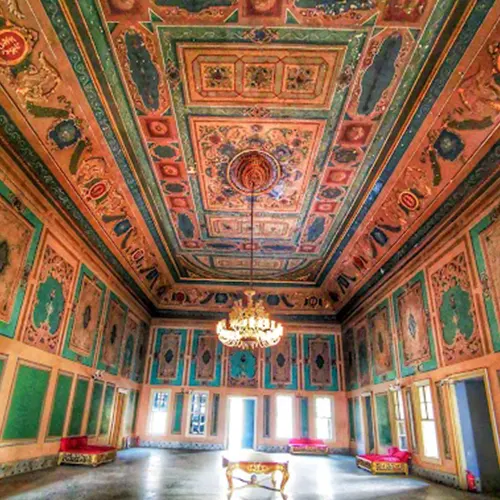
Monastery Palace on Rhoda Island

Monastery Palace is an artistic and architectural masterpiece overlooking the Nile River directly. Also, it is known as the Kiosk.

It was built by Hassan Fouad Pasha Al. Monastery, the Cairo Governor and Minister of the Interior in Abbas Pasha Period in 1851.

The palace is famous for its beautiful decorative style and wooden architecture design, and the music room has a ceiling taking the dome shape, making the music spread all over the room. Now, there are concerts are held in this room.

The Ministry of Antiquities turned this palace into a museum in 1951.

Additionally, there is a wooden bridge attached to this palace called the Monastery Bridge.  You will be able to take fabulous photos there.

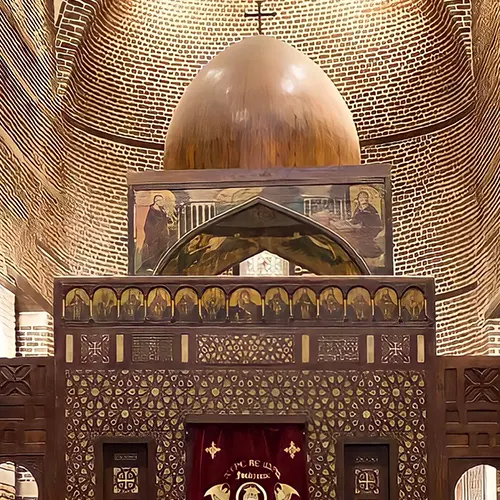
The Cavern Church – Abu Serga Church

The Cavern Church has several names, such as Abu Serga Church, the St. Sergius Church, and Saints Sergius and Bacchus Church. It lies in Coptic Cairo beside the Hanging church.

The church is dedicated to Sergius and Bacchus, who were soldier-saints martyred during the 4th century in Syria by the Roman Emperor Maximian.

The Importance of Abu Serga Church In this place, there is the cave where the Holy family (the Virgin Mary and the Christ) hid during their journey in Egypt, fleeing Roman persecution. After that, the church was founded upon this cave because of its sanctity.

The Hanging Church – Coptic Cairo

The Hanging Church is considered the oldest and most famous church in Egypt. It lies in Coptic Cairo beside the Babylon fortress.

The history of this church: This building was originally a Roman temple, but in the fourth century AD, after Christianity entered Egypt, it was transferred to be a church.

The Hanging Church became the seat of the Coptic Pope at the beginning of the eleventh century AD. Now, it is transferred to Abbasiya.

Let’s take a tour of the church: The first thing you will see is a group of mosaic icons referring to important events in Christianity, such as the miracle of transferring Mount Mokattam and the Journey of The Holy Family.

After that, you will see its Truss roof distinguishing this church. It is said that this roof referring to Noah’s Ark as a symbol of salvation and peace.

Then, you will enter the building of the church. It takes the Basilic design. At the end of the nave, there are three shrines for Mar Girgis, Virgin Mary, and John the Baptist.

At the end of this article, we will tell you why this church is called a hanging church. Originally, this church was called the Virgin Mary Church, but after that, it is called the Hanging Church because it was founded on two towers of the Babylon fortress, so it appeared as hanging.